Products
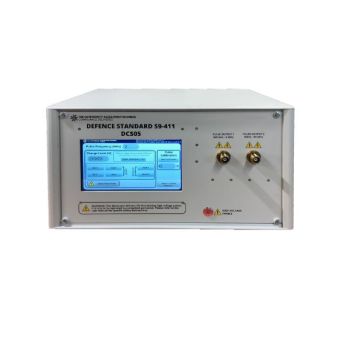
The Conformity Assessment Business Model DCS05 Test Generator. When coupled to its matched test clamp, the Generator produces damped oscillatory wave transients in the frequency range 500kHz to 50 MHz that meet the definition of a type 1N Generator verification requirements Defence Standard 59-411. 9 Fixed frequencies are available: 500 kHz, 1 MHz, 2 MHz, 3 MHz, 5 MHz, 10 MHz, 15 MHz, 35 MHz, and 50 MHz.
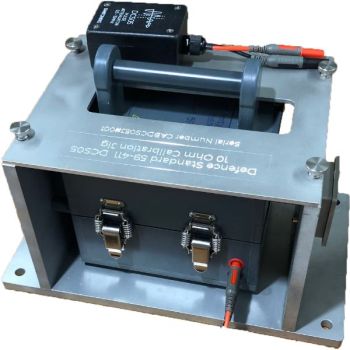
Matched test clamp for DCS05 Test Generator, the Generator produces damped oscillatory wave transients in the frequency range 500kHz to 50 MHz that meet the definition of a type 1N Generator verification requirements Defence Standard 59-411. 9 Fixed frequencies are available: 500 kHz, 1 MHz, 2 MHz, 3 MHz, 5 MHz, 10 MHz, 15 MHz, 35 MHz, and 50 MHz.
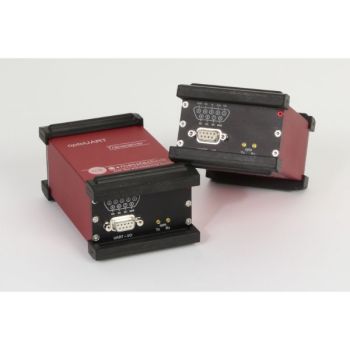
The optoUART system can be used for the optical transmission of UART-signals up to a data rate of 1 Mbit/s.
It can be used to transmit UART-signals over long distances or to handle ground potential problems. With the optical transmission and the shielded case, the system is well equipped for EMI and EME tests.
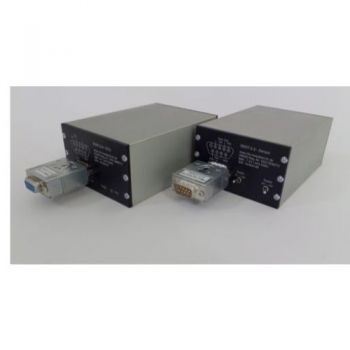
The optoSENT system was developed for the transmission of asynchronous SENT signals (Single Edge Nibble Transfer) and exists in two different versions.
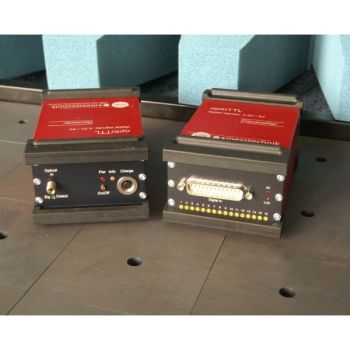
ptoTTL 5-3-u is used for the optical transmission of TTL (Transistor-Transistor Logic) 3.5 & 5 V TTL signals digital signals. Up to 16 digital signals with a sampling rate of 40 MS/s (each channel) can be transmitted. The system consists of a transmitter supplied by batteries, a simplex-62,5/125µm-multimode optical cable, and a receiver – which has integrated batteries as well.
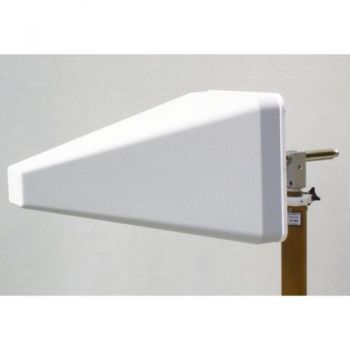
Stacked Logarithmic-Periodic Broadband Antenna for Linear polarised RX- and TX- applications in the microwave frequency range. The antenna structure is made of laser-cut brass. For the protection of the fine antenna structure against damage, the antenna is equipped with a low loss plastic protection cover. The STLP 9149 is especially suitable for Immunity Testing acc. to IEC 61000-4-3 because of its good field uniformity.
- (0.6)0.7-9 (10.5) GHz
- Gain 10.3 dBi +/- 1.5 dBi
- Type N female
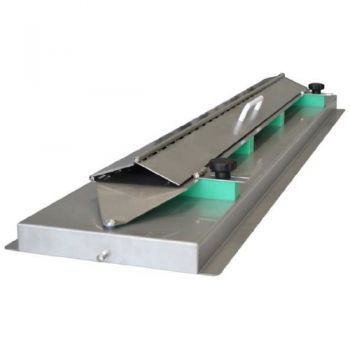
The coupling clamp CDN 2012 conforms exactly to the requirements of ISO 7637-3 and other standards, guaranteeing that tests are carried out in strict compliance with the standard. The CDN allows the fast nanosecond pulse bursts ( ISO 3a and 3b) to be injected in cable runs. Very high impedance signal lines are also to be found in vehicles on which the disruptive effects of ISO pulses 1 and 2 can also show up through capacitive coupling.
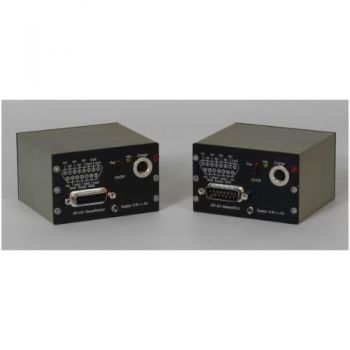
The optoSPI-HS system can be used for the bidirectional optical transmission of SPI signals with transmission rates of up to 1Mbit/s. It consists of two battery supplied transceivers connected to each other with an optical fiber. With the optical transmission of the shielded case and the external filter, the system is well equipped for EMI and EME tests.
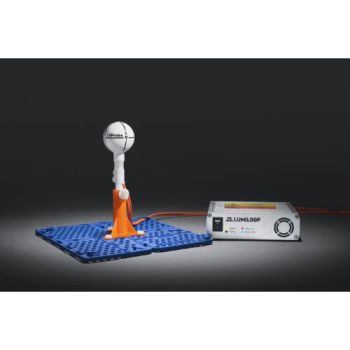
The LSProbe 1.2 Variant F Field Probe is a high-speed, high-accuracy, and high-dynamic range electric-Field probe.
- Its standard frequency range of 10 Hz – 8.2 GHz. 1,000 V/m
- Best-in-class compensation of linearity, frequency, and temperature guarantees accurate measurements from less than 0.1 to at least 1,000 V/m.
- A dynamic range of 100 dB is achieved for many frequencies, enabling Field measurements at more than 10,000 V/m.
- Customized high Field-strength „X“-variants, supporting up to 30,000 V/m and a damage level of 100,000 V/m, are available upon request.
The LSProbe 1.2 Variant E Field Probe is a high-speed, high-accuracy, and high-dynamic range electric-Field probe.
- Its standard frequency range of 10 kHz – 8.2 GHz. 15,000 V/m
- Best-in-class compensation of linearity, frequency, and temperature guarantees accurate measurements from less than 15 to at least 15,000 V/m.
- A dynamic range of 100 dB is achieved for many frequencies, enabling Field measurements at more than 10,000 V/m.
- Customized high Field-strength „X“-variants, supporting up to 30,000 V/m and a damage level of 100,000 V/m, are available upon request.