Products
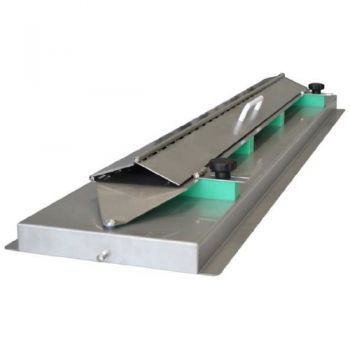
The coupling clamp CDN 2012 conforms exactly to the requirements of ISO 7637-3 and other standards, guaranteeing that tests are carried out in strict compliance with the standard. The CDN allows the fast nanosecond pulse bursts ( ISO 3a and 3b) to be injected in cable runs. Very high impedance signal lines are also to be found in vehicles on which the disruptive effects of ISO pulses 1 and 2 can also show up through capacitive coupling.
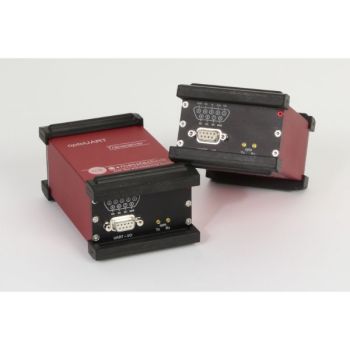
The optoUART system can be used for the optical transmission of UART-signals up to a data rate of 1 Mbit/s.
It can be used to transmit UART-signals over long distances or to handle ground potential problems. With the optical transmission and the shielded case, the system is well equipped for EMI and EME tests.
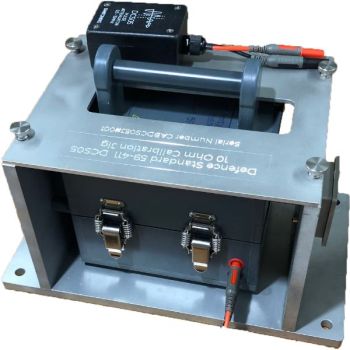
Matched test clamp for DCS05 Test Generator, the Generator produces damped oscillatory wave transients in the frequency range 500kHz to 50 MHz that meet the definition of a type 1N Generator verification requirements Defence Standard 59-411. 9 Fixed frequencies are available: 500 kHz, 1 MHz, 2 MHz, 3 MHz, 5 MHz, 10 MHz, 15 MHz, 35 MHz, and 50 MHz.
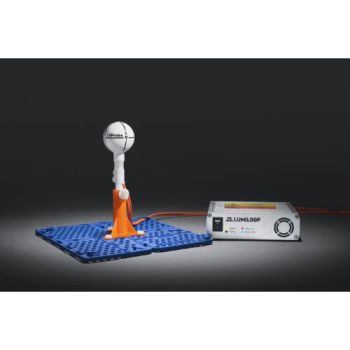
The LSProbe 1.2 Variant E Field Probe is a high-speed, high-accuracy, and high-dynamic range electric-Field probe.
- Its standard frequency range of 10 kHz – 8.2 GHz. 1,000 V/m
- Best-in-class compensation of linearity, frequency, and temperature guarantees accurate measurements from less than 0.1 to at least 1,000 V/m.
- A dynamic range of 100 dB is achieved for many frequencies, enabling Field measurements at more than 10,000 V/m.
- Customized high Field-strength „X“-variants, supporting up to 30,000 V/m and a damage level of 100,000 V/m, are available upon request.
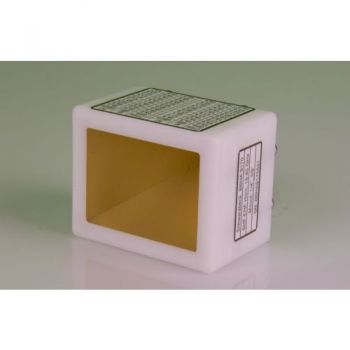
Broad-Band Horn Antenna
- 15 - 26.5 (40) GHz
- SMA-compatible connector
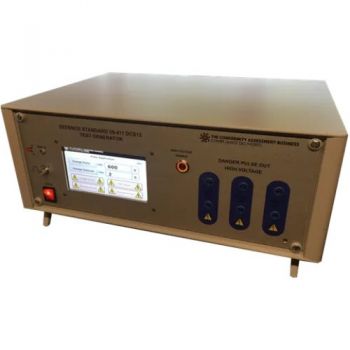
The Conformity Assessment Business Model DCS12 Test Generator meets all the DCS12 wave verification parameters for testing DC, single and three-phase equipment, that is source impedance and verification of damping and frequency when measured into a 10 Ω load. Output amplitude is software adjustable with permanent memory, should re-alignment be needed during calibration.
- There are three fixed outputs: 600 V, 750 V, and 2500 V
- 15.9 kHz ±10 %
- 10.9 kHz ±10 %
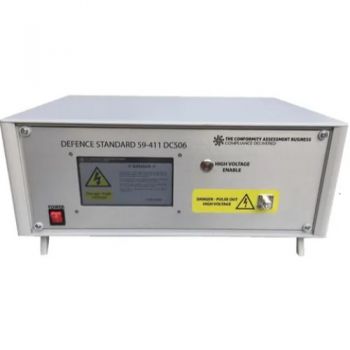
The Conformity Assessment Business Model DCS06 Test Generator has been designed to operate with its complementary injection clamp to fully meet the pulse requirements of DCS06 when tested into a 5? load. It operates from an intuitive touch screen interface and has full phase synchronization up to 800 Hz input frequency with 1-degree steps. It has been designed with future revisions of the test standard in mind.
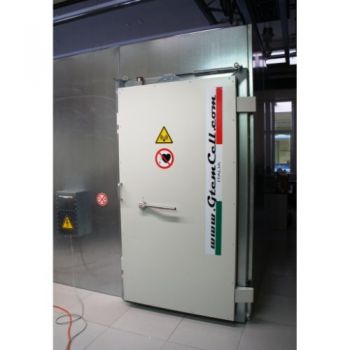
GTEMCELL Ltda shielded chambers are built up as modular construction. Due to individual modules, any size of the chamber can be realized. Big chambers may require an outer supporting structure or alternatively, the shielding material can be attached directly to the building. Panels are manufactured of 2,0 mm thickness hot galvanized sheet steel double bordered.
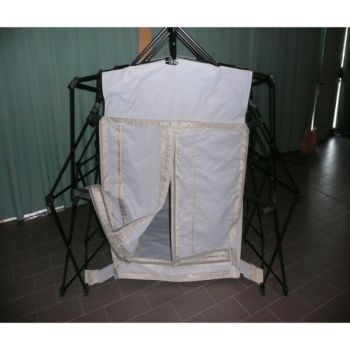
Gtemcell offers an innovative shielding product made of a highly conductive double layer of aluminum with internal reinforcing mesh in polyester for the coating and creation of shielded environments within pre-existing structures. The application frequencies range from a few Mega Hertz to several GHz with an electric field attenuation of 45-80dB. The great advantage is ease of application even on curved and complex surfaces and lower costs which make this application particularly attractive. GTEMCELL supplies the shielded fabric or performs all the environmental shielding work. The aesthetic finishes are the responsibility of the customer.
The construction includes a preliminary inspection to evaluate all the "critical" aspects such as the openings present: doors. windows, air conditioning systems, electrical connections and consequently draw up an economic evaluation of the costs.
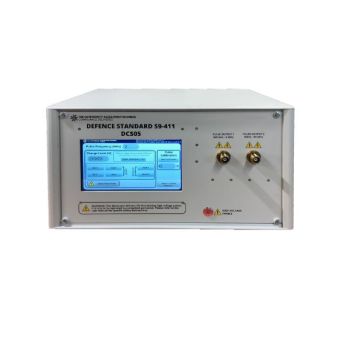
The Conformity Assessment Business Model DCS05 Test Generator. When coupled to its matched test clamp, the Generator produces damped oscillatory wave transients in the frequency range 500kHz to 50 MHz that meet the definition of a type 1N Generator verification requirements Defence Standard 59-411. 9 Fixed frequencies are available: 500 kHz, 1 MHz, 2 MHz, 3 MHz, 5 MHz, 10 MHz, 15 MHz, 35 MHz, and 50 MHz.