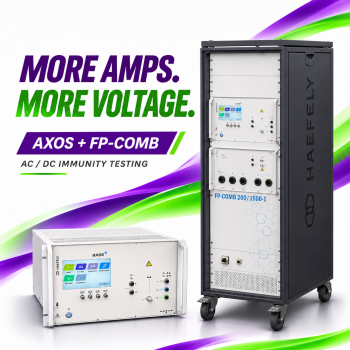
More Amps. More Voltage. One Smarter Plan for Immunity Testing. FP-COMB selection
More Amps. More Voltage. One Smarter Plan for Immunity Testing.
HAEFELY AXOS | EMC LAB SELECTION GUIDE
When the product gets bigger, the test setup has to grow intelligently. A high-current power converter, industrial drive or DC-powered assembly brings a different set of configuration questions to the EMC laboratory. The generator must supply the required disturbance, while the coupling/decoupling network must carry the EUT power and apply that disturbance correctly.
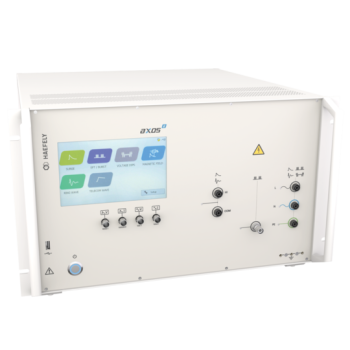
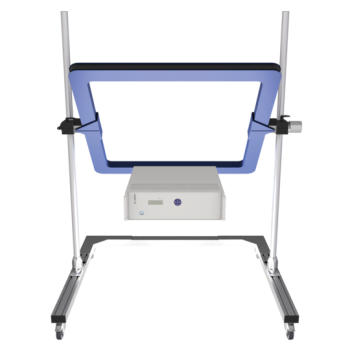
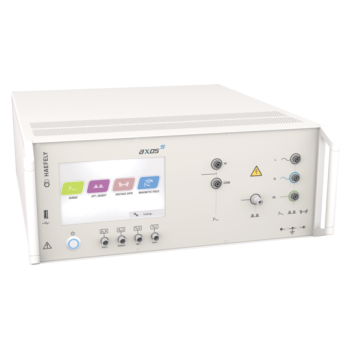
Haefely AXOS and FP-COMB make it possible to build around those two requirements separately. Select the generator functions for the tests, then choose the network for the power circuit. That distinction is the key to avoiding an expensive mismatch.
Start by separating three different ratings
| Rating | What it tells you | Why it matters |
|---|---|---|
| EUT operating voltage | The AC or DC supply voltage carried through the network. | Must suit the product supply and the selected connection arrangement. |
| EUT current | The load current carried by the network. | Must suit the operating conditions, with any specified derating considered. |
| Impulse capability | The disturbance voltage the network accepts for the specified waveform. | Must suit both the generator output and the intended test level. |
1500 V DC is an EUT supply rating. 7 kV is an impulse rating. They describe different parts of the test. Neither rating can substitute for the other.
Compare the FP-COMB power-line families
| Network / page | Current options | Power-circuit application |
|---|---|---|
| FP-COMB 32 | 32 A | Up to 480 V AC/DC phase-to-phase; evaluate its specific configuration. |
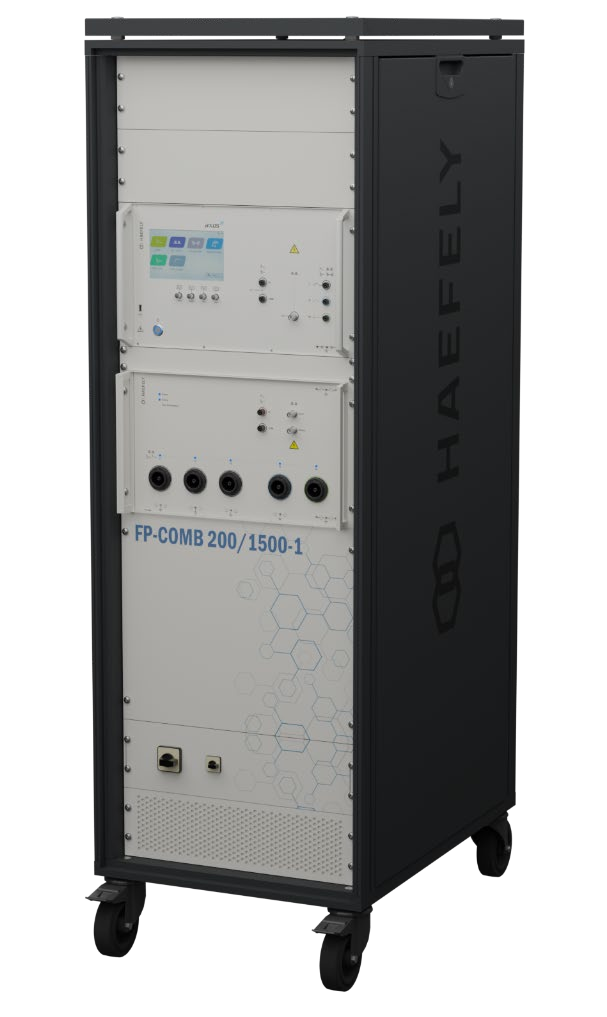
| FP-COMB /690-1 AC family | 63 / 125 / 200 A | Up to 690 V AC; limited DC ratings of 110 V at 63 A and 200 V at 125/200 A. |
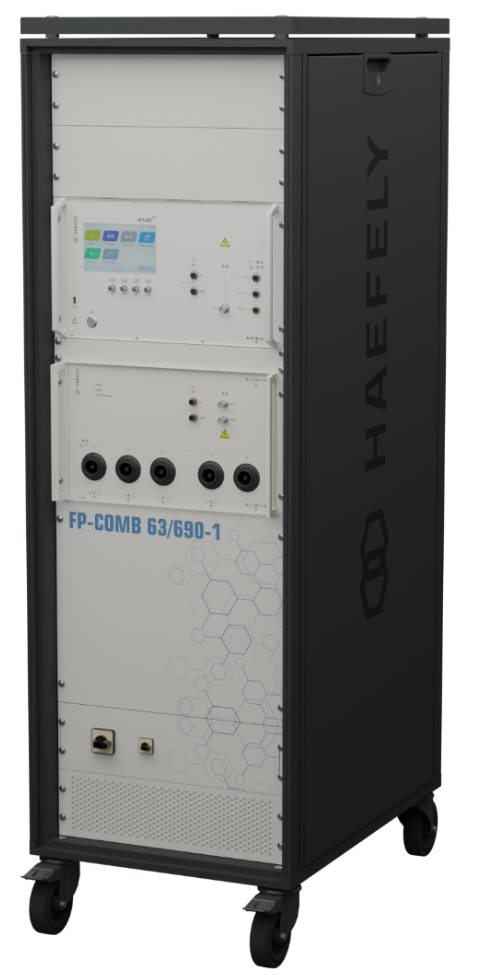
| FP-COMB /1500-1 DC family | 63 / 125 / 200 A | Up to 1500 V DC, subject to the specified load conditions. |
| FP-COMB /1500-1 with AC option | 63 / 125 / 200 A | High-voltage DC plus AC operation, including common 690 V AC applications; up to 1000 Vrms across DC-/DC+ in the specified AC configuration. |
The 63, 125 and 200 A networks accept up to 7 kV surge/ring-wave impulses and 5 kV EFT/burst impulses. The test system remains limited by the generator functions and ratings as well as the network. AXOS 5 does not become a 7 kV surge generator when connected to a 7 kV-rated network.
690 V AC: choose around the actual supply
For single- and three-phase AC equipment, list the phase-to-phase voltage, frequency, operating current and required coupling paths. The /690-1 family is the starting point for many 690 V AC applications. Its DC capability is limited; it should not be treated as the 1500 V DC family.
Current selection deserves more attention than choosing the nearest number above the nameplate. Review the product’s operating modes and inrush, then check the network’s conditions for voltage and frequency. Confirm the physical connectors, cables and test-site supply arrangement before ordering.
1500 V DC: include the load in the conversation
For a high-voltage DC program, begin with the /1500-1 family. Share the load characteristics with Absolute EMC, including inductance and the intended operating conditions. The headline voltage is only useful when the actual application meets the manufacturer’s specified conditions.
The DC family can be configured with the AC option when the laboratory also needs AC work. This gives a mixed-product laboratory a configuration path without treating an AC-only setup as interchangeable with the DC network.
AC+DC: plan once for a broader workload
Many laboratories search for “690 V AC” because it describes a familiar industrial supply. The AC-option technical data also specifies operation up to 1000 Vrms. State the exact terminals, phase arrangement and voltage in the application review; do not assume that 1000 Vrms applies to every possible three-phase connection.
The combined configuration is worth evaluating when the laboratory’s workload includes both AC products and high-voltage DC equipment. Select the current rating and required options around that mix, and define which connections and test sequences will be used for each product family.
Automation is valuable when the coupling path changes
FP-COMB works with AXOS control to select the appropriate coupling arrangements for supported tests. That is useful when a campaign includes multiple paths and repeated sequences: fewer manual reconnections can make the procedure easier to manage. The engineer still verifies the setup and observes the EUT response.
Five details that make the quotation useful
| Provide | Include |
|---|---|
| Supply and load | AC/DC, voltage, frequency, phase arrangement, current, inrush and load inductance. |
| Test requirements | Waveforms, maximum levels, coupling paths and applicable procedures. |
| Generator configuration | AXOS platform and installed functions. |
| Installation | Supply connections, cable requirements, grounding and test-site safety arrangements. |
| Operating workflow | Required power-switch options, control, calibration and verification equipment. |
More power should bring more capability, not more uncertainty. Compare the 32 A, 690 V AC, 1500 V DC and AC+DC pages, then configure the network around the product you actually need to test.
Technical downloads: FP-COMB AC datasheet and FP-COMB DC / AC-option datasheet.