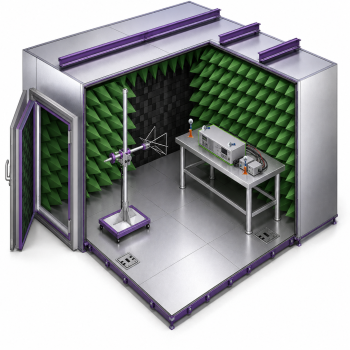
Improving RS103 Radiated Immunity Accuracy with Multiple Field Probes
Improving RS103 Radiated Immunity Accuracy with Multiple Field Probes
Radiated immunity testing under MIL-STD-461 has always presented a difficult challenge for EMC engineers. Generating field strength is only one part of the problem. The far more difficult task is ensuring the Equipment Under Test (EUT) is actually being illuminated properly throughout the entire test volume, across the full frequency range, while avoiding unnecessary over-testing or localized under-testing caused by chamber behavior, antenna characteristics, and field distortion.

MIL-STD-461H provides important clarification that helps move RS103 testing toward a more accurate and repeatable methodology. In Appendix A, the standard explicitly allows the use of multiple electric field sensors and states that the effective field is determined by averaging the readings from those probes. This is a major improvement in guidance because it acknowledges the practical reality of radiated immunity testing: the electromagnetic field surrounding an EUT is rarely uniform, especially over wide frequency ranges and across physically large equipment.
The standard states:
“The use of more than one sensor is acceptable, provided all sensors are within the beamwidth of the transmit antenna. The effective field is determined by taking the average of the readings.”
This clarification is significant because it recognizes that relying on a single probe location may not accurately represent the electromagnetic environment surrounding the EUT.
For many years, RS103 setups commonly relied on a single field probe placed near the center of the test volume. While this method satisfies basic closed-loop field control requirements, it often fails to account for the complex interactions occurring within the chamber. The EUT itself affects the field. The ground plane affects the field. The test table affects the field. Chamber reflections affect the field. Antenna beamwidth changes continuously over frequency. Even cable positioning and enclosure geometry can dramatically alter local field intensity.
These effects become even more pronounced at lower frequencies where wavelengths are extremely large and antenna efficiency is reduced. MIL-STD-461H specifically discusses these challenges, particularly with biconical antennas at lower frequencies, noting that harmonics may radiate more efficiently than the fundamental frequency. The appendix explains that one method to avoid this issue is to use physically larger radiators or transmission line style radiators at lower frequencies.
The use of multiple probes dramatically improves visibility into these field behaviors.
With two probes positioned across the illuminated area, engineers immediately gain a better understanding of field symmetry and antenna coverage. A two-probe arrangement can reveal chamber nulls, antenna beam skewing, reflections, and localized overdrive conditions that would otherwise remain hidden when monitoring only a single point in space.
A three-probe arrangement is even more effective for most tabletop EUT configurations. Positioning probes on both sides of the illuminated area with an additional probe in the center allows the engineer to observe how the field distribution changes as frequency increases and antenna characteristics evolve. This becomes especially important during antenna transitions between biconical antennas, stacked log periodic antennas, and horn antennas, all of which have significantly different beam patterns and illumination characteristics.
Using multiple probes creates a much more representative understanding of the actual electromagnetic environment surrounding the EUT. Instead of controlling the amplifier to satisfy one localized field point, the test system regulates toward the average illuminated condition across the EUT volume.
MIL-STD-461H even provides a direct averaging example:
If three probes measure:
- 30 V/m
- 22 V/m
- 35 V/m
then the effective field is calculated as:
E-Fieldeffective= (30 + 22 + 35) / 3 = 29V/m
This averaging methodology provides substantial benefits for real-world immunity testing.
In many chambers, achieving field strength at one isolated probe location often forces the amplifier to overdrive the chamber, producing excessive fields elsewhere within the illuminated volume. Engineers frequently spend large amounts of time repositioning antennas, adjusting probe locations, modifying chamber absorbers, or increasing amplifier power simply to overcome localized nulls that may not represent the actual exposure seen by the EUT.
Multiple probe averaging helps eliminate this problem.
In some frequency regions, averaging multiple probes may require slightly more forward power because localized hotspots can no longer falsely satisfy the test level. In other frequency regions, averaging may actually reduce the required power because the average field distribution is more representative than a single low-field null. The result is a much more balanced and technically accurate test.
This approach also significantly improves testing efficiency.
One of the largest hidden costs in RS103 testing is setup optimization time. Engineers routinely spend hours adjusting antenna positions, chamber layouts, and amplifier settings attempting to achieve stable field levels. Multiple probe monitoring greatly streamlines this process by providing immediate visibility into how the field behaves across the entire illuminated region rather than at a single isolated point.
The benefits become even greater when testing large or tall EUTs.
Four or more probes distributed vertically and horizontally across the illuminated region provide substantially better confidence that the entire EUT is being exposed correctly. This is especially important for rack systems, large enclosures, multi-box assemblies, and equipment with extensive cable harnessing where field gradients can vary dramatically from top to bottom.
The standard itself recognizes the importance of true field measurement. Appendix A emphasizes that sensors used under non-far-field conditions must directly sense electric field rather than infer E-field from magnetic field or power density measurements.
This becomes critically important below 200 MHz, where reactive field behavior dominates, and field distribution becomes highly dependent on surrounding chamber and setup geometry.
Fast-response field probes further improve RS103 testing quality.
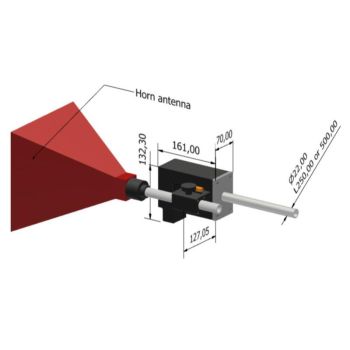
MIL-STD-461 RS103 testing commonly uses 1 kHz square-wave modulation with a 50 percent duty cycle. Slow-response field probes may not correctly track the modulation envelope, leading to inaccurate field readings and unstable closed-loop control behavior. Modern fast-response probes from LUMILOOP, capable of accurately following pulsed and square-wave modulation in real time, provide dramatically improved control stability and measurement confidence.
Likewise, fast-response broadband power monitoring is equally important.
Forward power measurement systems with insufficient response speed may fail to properly capture amplifier behavior during modulation peaks. This can lead to field overshoot, incorrect amplifier regulation, and inconsistent field control. A properly designed immunity system should use high-speed field sensing together with fast-response forward power monitoring to maintain accurate closed-loop regulation throughout the sweep.
The combination of:
- multiple field probes,
- fast-response electric field sensing,
- and high-speed power monitoring,
creates a far more stable, repeatable, and technically accurate immunity test environment.
Ultimately, the goal of EMC testing is not simply to pass a specification. The goal is to produce accurate, repeatable, and technically defensible test results that correlate to real-world electromagnetic environments without unnecessarily overstressing the EUT.
Multiple probe RS103 testing moves the industry significantly closer to that goal.
It improves reproducibility between laboratories. It improves confidence in immunity margins. It reduces unnecessary over-testing. It minimizes the risk of under-testing caused by localized chamber behavior. It improves closed-loop control stability. It reduces setup optimization time. Most importantly, it produces a more representative electromagnetic exposure across the entire EUT.
As MIL-STD-461H continues to evolve toward more realistic and technically rigorous radiated immunity testing methodologies, the use of multiple field probes represents one of the most important practical improvements EMC laboratories can implement today.
Tips on Probe Placement
There is no single probe arrangement that is correct for every RS103 setup.
Probe placement should be selected based on:
- EUT dimensions
- Antenna type
- Antenna beamwidth
- Antenna polarization
- Frequency range
- Test distance
- Chamber geometry
- Ground-plane configuration
- Cable configuration
As a general approach:
1. Keep all averaging probes within the antenna beamwidth.
Do not include probes significantly outside the intended illuminated region in the calculated effective field.
2. Position probes around the region of the EUT being illuminated.
Probe placement near the outer portions of the EUT can provide useful information about field coverage.
3. Avoid unnecessarily shielding a probe with the EUT.
The probe should represent the incident field around the EUT rather than a location that is heavily shadowed by the equipment.
4. Consider vertical as well as horizontal coverage.
Tall equipment may require probes at multiple heights.
5. Evaluate placement at the highest frequency of each antenna range.
This is typically where the beam is narrowest and probe placement becomes most critical.
6. Window the EUT when necessary.
If the antenna cannot adequately illuminate the complete EUT, divide it into multiple illuminated test regions rather than attempting to force one antenna position to cover everything.
7. Document probe locations.
Probe coordinates and configuration should be recorded as part of the test setup so the measurement can be repeated.
Summery Table
| Advantages of Multiple Probes | Challenges / Considerations |
| More accurate field measurement across the EUT | More setup complexity |
| Better confidence the full EUT is illuminated | Requires proper probe placement |
| Helps identify chamber reflections and field nulls | More data to review |
| Improves test repeatability | Additional equipment cost |
| Reduces risk of over-testing | Some frequencies may require more amplifier power |
| Reduces risk of under-testing | Probe averaging must be done correctly |
| Improve testing of large or tall EUTs | Larger setups may need more probes |
| Faster setup optimization | Initial setup can take longer |
| Better closed-loop field control | Control software may need adjustment |
| Helps during antenna transitions over frequency | Probe positions may need optimization |
| Better understanding of chamber behavior | Requires trained operators |
| Can reduce unnecessary amplifier overdrive | Some chambers may still have difficult nulls |
| Improves confidence in RS103 results | Procedures should clearly document probe locations |
| Better field uniformity verification | Probe calibration consistency is important |
| Improves pulse/square-wave modulation accuracy with fast probes & power meter | Slow probes reduce the benefit |
| Improves overall EMC test quality | Requires investment in quality probes and meters |
A Better View of the Test Environment
The purpose of RS103 testing is not simply to generate a particular number on a field probe.
The objective is to expose the EUT to a controlled electromagnetic environment that meets the requirements of the test while producing accurate, repeatable, and technically defensible results.
Multiple field probes provide the test engineer with a much better understanding of that environment.
They can:
- Reveal field gradients
- Identify localized nulls
- Detect excessive field levels
- Improve antenna positioning
- Improve testing of large EUTs
- Assist with EUT windowing
- Reduce unnecessary over-testing
- Reduce the risk of under-testing
- Improve closed-loop control
- Reduce setup optimization time
Most importantly, multiple probes provide a more representative view of the RF field surrounding the EUT than a single isolated measurement point.
Moving RS103 Testing Forward
MIL-STD-461H's clarification regarding the use of multiple electric-field sensors provides laboratories with an important tool for improving RS103 testing.
A single probe remains appropriate for many setups, particularly when the EUT is small and the illuminated region is well controlled.
But as EUT size increases, frequencies rise, antenna beams narrow, and chamber interactions become more complex, multiple field probes can provide substantially more information about the actual electromagnetic environment surrounding the equipment.
When multiple probes are combined with fast-response field measurement, high-speed forward-power monitoring, appropriate antenna selection, and properly implemented closed-loop control, RS103 testing becomes easier to understand, easier to optimize, and more technically defensible.
The result is not simply more measurement data.
It is better control of the electromagnetic environment being applied to the EUT.