Do Comb Generators Require Calibration for EMI Measurement Laboratories?
Introduction
Comb generators are widely used in electromagnetic interference (EMI) measurement environments to provide a repeatable, broadband reference signal. They serve as convenient tools for verifying radiated and conducted emission test setups, validating measurement paths, and ensuring long-term system stability.
A frequent question from users and auditors is whether a comb generator itself requires calibration. In practice, the answer depends on how the device will be used within the facility’s quality and traceability framework.
Function of a Comb Generator in EMI Testing
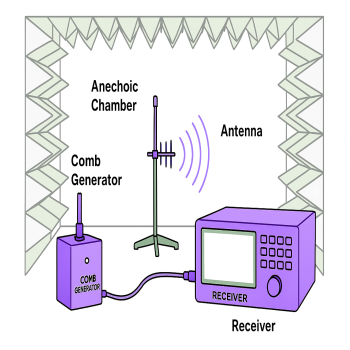
A comb generator creates a series of harmonic output lines across a broad frequency range. When radiated through an antenna or injected into a measurement path:
- The pattern of harmonic peaks confirms that receivers, antennas, cables, LISNs, and spectrum analyzers are functioning.
- Measured amplitude variations can identify setup drift, cable damage, gain/loss changes, or improper configuration.
- Because the output is extremely stable, changes in measured level are typically associated with the measurement system, not the generator.
Most well-designed comb generators maintain long-term amplitude stability within ±1 to 2 dB without adjustment.
When Calibration Is Needed
Calibration is recommended when the comb generator is being used as a traceable reference for direct comparison to a third-party or accredited laboratory.
You should pursue calibration if:
- You want to compare your radiated or conducted emissions levels to results from an accredited EMI lab you routinely use.
- The device is being used as a reference artifact to demonstrate the correlation of measurements between facilities.
In this case, having the accredited lab calibrate the comb generator is advantageous. Their calibration data becomes the reference amplitude, allowing you to directly correlate your chamber or bench setup to theirs. This is the most reliable method to ensure alignment of results between organizations, especially when performing pre-compliance measurements intended to predict formal certification outcomes.
When Calibration Is Not Required
If the comb generator is used primarily as a functional confidence check, routine calibration may not be needed. Typical examples include:
- Verifying test setup integrity before or during routine testing
- Confirming that cables, antennas, preamps, analyzers, and switching paths are operational
- Establishing a long-term stability baseline for internal quality control
- Spot-checking chamber performance over time
In these use cases, the absolute amplitude value is less important than the consistency of the generated harmonics. Because quality comb generators have extremely stable output over time, tracking measurements at periodic intervals is sufficient to detect system degradation.
For internal QA use, it is common to:
- Measure the comb generator at periodic intervals
- Log its harmonic levels as a baseline
- Investigate deviations (typically due to cables, antennas, preamps, or analyzers)
No formal calibration is necessary when the comb generator is not being treated as a traceable reference standard.
Critical Specifications to Consider
For any application, the two most important characteristics of a comb generator are:
- Output Level
- Should match the system dynamic range and provide usable peaks across the intended frequency band.
- Excessive output can saturate preamplifiers or receivers; insufficient output can mask system issues.
- Long-Term Stability
- The generator must produce consistent harmonic amplitudes over time.
- Stability is what allows the user to identify variation in the test environment, rather than in the source.
Well-engineered comb generators remain stable for many years, which is why they are favored as reference sources.
Conclusion
A comb generator does not automatically require calibration simply because it is used in an EMI measurement laboratory.
- If the device is used as a traceable reference to correlate results with an accredited lab or align measurement systems, calibration is recommended.
- If the device is used primarily for setup verification, problem diagnosis, or long-term consistency checks, calibration is typically unnecessary.
Ultimately, the decision depends on whether the comb generator functions as a measurement reference or as a quality assurance tool. When used correctly, it remains one of the simplest and most effective methods for confirming test system performance and detecting drift over time. EMC Instruments makes one of the most comprehensive lines of comb generators on the market . Units that cover all EMC applications and frequencies. Absolute EMC is honored to offer them exclusively in North America.
Related Article: Comb Generator Selection Guide
Related Article: One Comb Generator can fit all your needs