Click Measurement (Discontinuous Disturbances)
Click Measurement (Discontinuous Disturbances)
CISPR 14-1 Testing with EMSCOPE and Clickmeter
Discontinuous disturbances—commonly called clicks—are short-duration switching events that occur on the mains during normal operation of many electrical products. Unlike continuous conducted emissions, clicks are evaluated statistically and must be assessed according to a structured decision process defined in CISPR 14-1. Correct implementation requires compliant detectors, controlled impedance, event counting, duration classification, and rule-based logic.
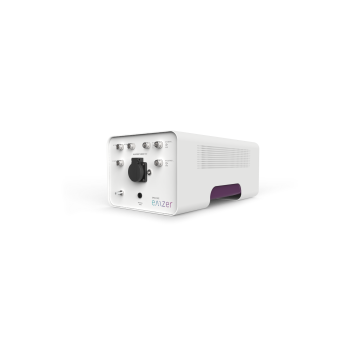
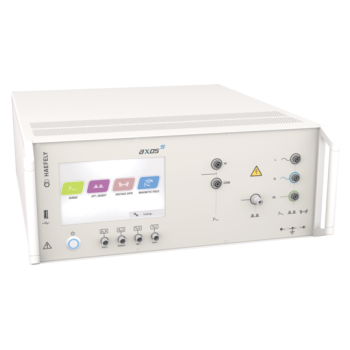
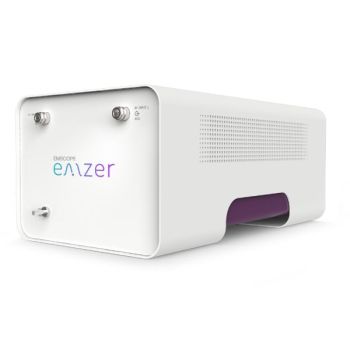
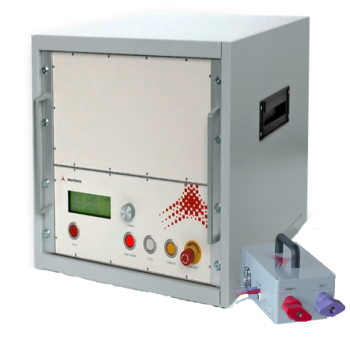
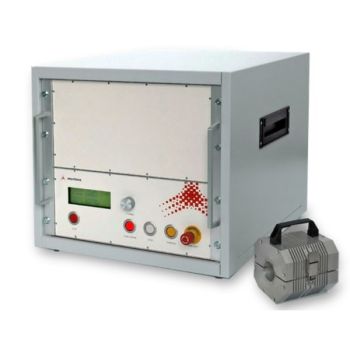
The EMSCOPE platform with the Clickmeter option is purpose-built to execute this workflow in a single integrated system. It combines measurement hardware, a CISPR-compliant LISN, automated statistical evaluation, and report generation within a modern web-based architecture.
Understanding Click Measurements Under CISPR 14-1
Click testing differs fundamentally from broadband conducted emissions sweeps. The objective is not to characterize a continuous spectral profile, but to detect and classify transient switching events and determine whether their repetition rate and amplitude exceed allowable statistical thresholds.
The standard requires measurements at four discrete frequencies:
- 150 kHz
- 500 kHz
- 1.4 MHz
- 30 MHz
At each frequency, both Peak and Quasi-Peak detection must be applied in accordance with CISPR 16-1-1 . The quasi-peak detector is particularly important because it weights repeated events more heavily than isolated disturbances, reflecting the perceived impact on radio reception.
Beyond amplitude, the test requires determination of click rate, number of clicks (Nc), the number exceeding derived thresholds (Lq), duration categories, and rule-based conditions such as the 600 ms rule and instantaneous switching criteria. The compliance decision is therefore the result of a defined statistical and logical sequence, not a single trace comparison.
EMSCOPE with Clickmeter – An Integrated Approach
The Clickmeter is an advanced licensed measurement option available for the EMSCOPE platform . It is designed and manufactured in accordance with CISPR 16 and fully meets CISPR 14-1 requirements for discontinuous disturbance measurement .
Simultaneous Line and Neutral Measurement
EMSCOPE measures Line and Neutral simultaneously . In many traditional implementations, conductors are evaluated sequentially, which increases total test time and can introduce variability when disturbances are not perfectly repeatable. Simultaneous acquisition ensures both conductors are evaluated under identical EUT operating conditions.
Common-Mode and Differential-Mode Insight
The system also provides physical (Line/Neutral) and modal (Common-mode and Differential-mode) conducted emissions information simultaneously . This capability is particularly valuable during product development. Engineers can immediately determine whether a disturbance is dominated by common-mode coupling or differential-mode behavior, enabling more efficient filter and layout optimization.
Four Simultaneous Frequency Displays
The Clickmeter interface displays all four required frequency points concurrently . Each plot includes regulatory limits and detector traces, allowing real-time visualization of event behavior across the band. This eliminates the need for sequential frequency switching and improves diagnostic clarity during troubleshooting.
Built-In CISPR Infrastructure
The Clickmeter integrates key measurement elements into one platform:
- Peak and Quasi-Peak detectors compliant with CISPR 16-1-1
- Built-in LISN compliant with CISPR 16-1-2
- 50 Ω RF input with low VSWR
- Integrated transient limiter up to 30 MHz
- Artificial hand (510 Ω + 220 pF)
The integrated LISN supports up to 16 A continuous current at 230 VAC (socket dependent) and operating voltages up to 300 VAC / 325 VDC (socket dependent) . By consolidating the measurement chain, the system reduces interconnection variability and improves repeatability between tests.
Automated Statistical Evaluation and Reporting
A defining feature of the Clickmeter is its automated evaluation engine. The system calculates click rate, exceedance levels, duration bins, rule conditions, and final pass/fail outcomes internally, presenting results in a structured summary table .
This eliminates manual spreadsheet processing and reduces interpretation variability between operators. For accredited laboratories and internal compliance teams, consistent automated logic strengthens confidence in the final result.
The Clickmeter also generates a complete PDF report that compiles plots, summary tables, and a flow representation of the CISPR 14-1 decision structure . Reports are suitable for customer documentation, internal design reviews, and traceable compliance records.
Web-Based Operation
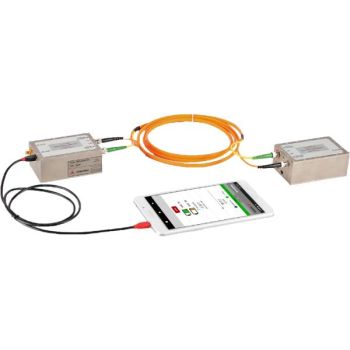
EMSCOPE uses a self-contained web-based architecture. Users access the instrument via browser using its IP address, with no external software installation required .
This simplifies IT management, supports network-based laboratory workflows, and removes operating system compatibility concerns common with traditional receiver software installations.
Applications
Click measurement is commonly required for products that include repetitive switching functions, including:
- Household appliances with thermostatic control
- Motor-driven tools and devices
- Lighting products with switching regulators
- Industrial control equipment
- Power control systems with relays or triacs
In both compliance and pre-compliance environments, accurate discontinuous disturbance evaluation reduces the risk of late-stage certification delays and supports faster design iteration.
Typical Test Setup
A typical click measurement configuration using EMSCOPE includes:
- The EUT connected to the built-in LISN of the Clickmeter.
- Line and Neutral measured simultaneously at the required frequencies.
- Detector application (Peak and Quasi-Peak) in accordance with CISPR 16.
- Automated click counting and rule evaluation within the EMSCOPE interface.
- Generation of a consolidated PDF compliance report.
Because the LISN and evaluation engine are integrated, the setup reduces external cabling complexity and minimizes potential impedance inconsistencies.
Conclusion
Click testing under CISPR 14-1 is not a simple amplitude measurement—it is a structured statistical evaluation of transient disturbances. Proper execution requires compliant detectors, controlled impedance, accurate event detection, and consistent application of decision rules.
EMSCOPE with Clickmeter integrates these requirements into a single, standards-aligned platform. With simultaneous Line/Neutral acquisition, modal analysis capability, built-in LISN, automated statistical evaluation, web-based operation, and instant report generation , the system supports both rigorous compliance verification and efficient engineering troubleshooting.
For laboratories and manufacturers seeking repeatable, standards-conformant discontinuous disturbance testing, this integrated architecture provides a technically robust and operationally efficient solution.