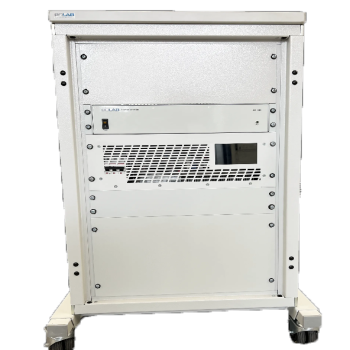
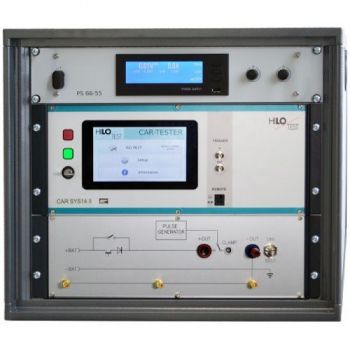
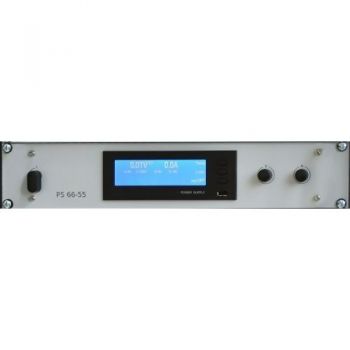
PS 66-55 Power supply 66V/55A Battery Supply
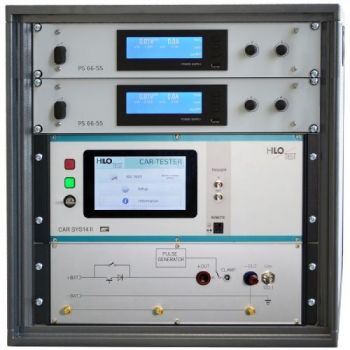
PS 66-110 Power Supply 66V/110A Battery Simulator
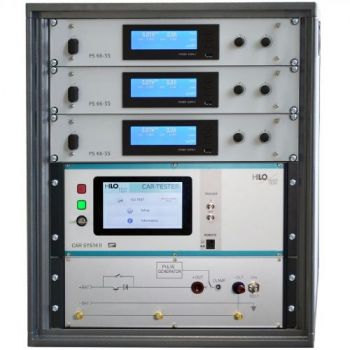
PS 74-220 Power Supply 74V/220A Battery Simulator
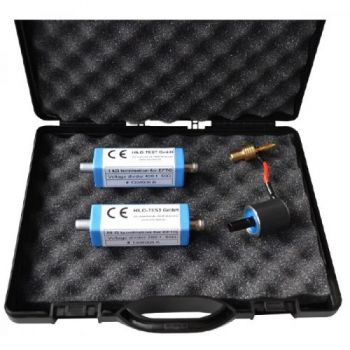
BCK 400 F Calibration kit for EFT/burst Generators

CAR CDN 2012 EFT/Burst Capacitive Coupling Clamp ISO
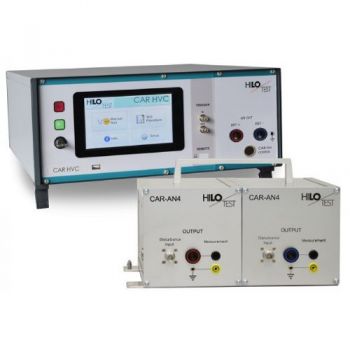
CAR AN-HV Artificial Network High Voltage
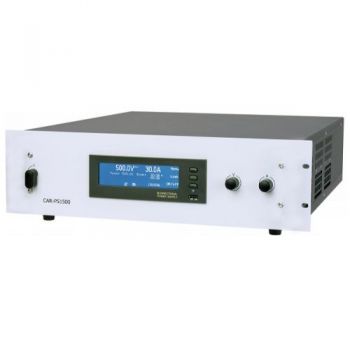
CAR PS 1500, 1500V Battery Simulator
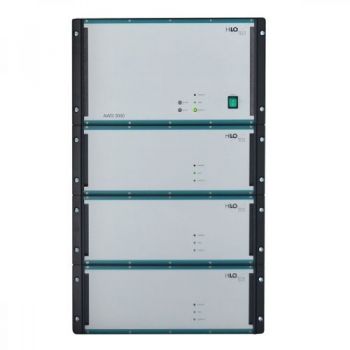
CAR AWG 3000, 4-quad, 100A Battery Simulator
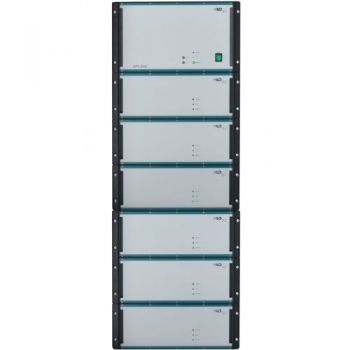
CAR AWG 6000, 4-quad, 200A Battery Simulator
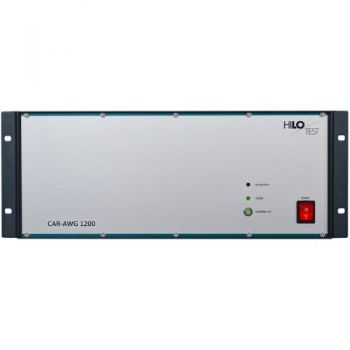
CAR AWG 1200, 4-quad, 40A Battery Simulator
CAR LD-PS Amplifier Load Dump
Products
305-AC, 0-305V, 30->1050kVA, AC Power Supply
- Technologically advanced, fast-switching, compact 19-inch power supplies
- High control dynamics in the 100...200 µs range – even at higher power levels
- Exceptional current accuracy of <0.02% FS, additional high-resolution current measurement range included as standard
- Full power regeneration and a high degree of efficiency, resulting in a significant reduction of energy consumption and heat dissipation, low acoustic noise
- Wide current-voltage range with an auto-ranging factor of 3
- Full digital CV, CC, CP, CR, and Ri-Sim control modes
PS 66-55 Power supply 66V/55A Battery Supply
Power supply to expand the CAR-SYS 14 for the tests according to ISO 7637 and ISO 16750-2.
PS 66-110 Power Supply 66V/110A Battery Simulator
Power supply to expand the CAR-SYS 14 for the tests according to ISO 7637 and ISO 16750-2.
PS 74-220 Power Supply 74V/220A Battery Simulator
Power supply to expand the CAR-SYS 14 for the tests according to ISO 7637 and ISO 16750-2.
BCK 400 F Calibration kit for EFT/burst Generators
The Burst Calibration Kit has been designed to measure the pulse output voltage and the pulse output current of burst generators, e.g. the EFTG-CE5 or the burst generator sub-unit of the Multi-CE5. It essentially consists of a load resistor, a pulse voltage divider, and a double-shielded coaxial cable. ? Burst Calibration Kit ? Input voltage: 5 kV ? Ratio, 200/400:1 ? Bandwidth: 400 MHz
CAR CDN 2012 EFT/Burst Capacitive Coupling Clamp ISO
The coupling clamp CDN 2012 conforms exactly to the requirements of ISO 7637-3 and other standards, guaranteeing that tests are carried out in strict compliance with the standard. The CDN allows the fast nanosecond pulse bursts ( ISO 3a and 3b) to be injected in cable runs. Very high impedance signal lines are also to be found in vehicles on which the disruptive effects of ISO pulses 1 and 2 can also show up through capacitive coupling.
CAR AN-HV Artificial Network High Voltage
CAR AN-HV is used to simulate various types of transients that appear on the high voltage supply lines generated by the switching of various devices.
Pulse A represents ringing caused by switching operations of high voltage semiconductors. Pulse B represents sinusoidal waves generated by harmonics from the grid and revolutions from, for example, electric propulsion motors.
CAR PS 1500, 1500V Battery Simulator
- Battery simulator
- Vehicle voltage up to 1500V
- Fast rise time up to 100V/μs
- Battery current: 30A
- Constant power: 15kW
CAR AWG 3000, 4-quad, 100A Battery Simulator
The CAR arbitrary waveform generator 3000 is a compact EMC testing system for performing voltage variations on supply lines of vehicles. The system strictly complies with the international standards and manufacturer standards that describe phenomena on the power supply of vehicles. Thus, the CAR arbitrary waveform generator 3000 is the optimal voltage power source for battery simulation up to 70V. It can simulate pulse 2b, pulse 4, starting profile, superimposed alternating voltage and others, up to a battery current of 100A.
CAR AWG 6000, 4-quad, 200A Battery Simulator
The CAR arbitrary waveform generator 6000 is a compact EMC testing system for performing voltage variations on supply lines of vehicles. The system strictly complies with the international standards and manufacturer standards that describe phenomena on the power supply of vehicles. Thus, the CAR arbitrary waveform generator 6000 is the optimal voltage power source for battery simulation up to 70V. It can simulate pulse 2b, pulse 4, starting profile, superimposed alternating voltage, and others, up to a battery current of 100A.
CAR AWG 1200, 4-quad, 40A Battery Simulator
The CAR arbitrary waveform generator 1200 is a compact EMC testing system for performing voltage variations on supply lines of vehicles. The system strictly complies with the international standards and manufacturer standards that describe phenomena on the power supply of vehicles. Thus, the CAR arbitrary waveform generator 1200 is the optimal voltage power source for battery simulation up to 70V. It can simulate pulse 2b, pulse 4, starting profile, superimposed alternating voltage and others, up to a battery current of 40A.
CAR LD-PS Amplifier Load Dump
CAR LD-PS includes generation of pulses #5 / Test A and Test B. It is designed to be connected to the power supply interface of the CAR-SYS.